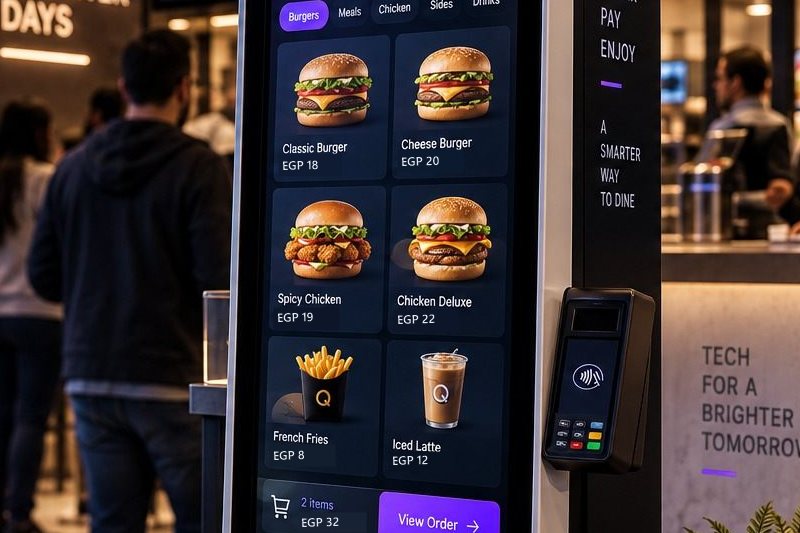
To a skeptical owner, a self-ordering kiosk looks like an expensive screen doing a cashier's job. To the global QSR chains that now put them in every new branch, kiosks are one of the most reliable revenue tools in the building. Both views come from the same machine - the difference is whether it is deployed where its mechanisms actually work.
So let us skip the hype and walk through what actually changes when kiosks go in - and where they genuinely do not pay.
The four things that actually change
1 - Queues stop costing you customers
Every long queue quietly loses sales: people glance at the line, estimate the wait, and walk away - you never see the order that did not happen. Kiosks add parallel ordering capacity exactly at peak, when hiring another cashier for two rush hours a day makes no sense. Three ordering points instead of one changes what the queue looks like from the door.
2 - Baskets get bigger
This is the most consistently reported effect across chains worldwide, and the mechanics are simple: customers browse without pressure, photos sell better than a shouted menu, nobody feels awkward adding extra cheese to a screen, and the kiosk offers the upsell every single time, at the right moment - something no busy cashier does reliably. Double-digit basket growth is the norm global QSR operators describe, and the mechanism travels well.
3 - Orders come out right
When the customer builds the order personally, "I said no onions" arguments mostly disappear. Fewer remakes means less wasted food, faster lines and calmer counters - a saving that never shows on a brochure but shows up every day.
4 - Staff move to where the value is
Kiosks do not fire anyone; they redeploy. Fewer people repeating orders into a till, more people preparing and handing out food - which is where speed and quality are actually made. Same payroll, more output.
The honest math
And the honest caveat: a kiosk fixes an ordering bottleneck, not a kitchen bottleneck. If your queue exists because the kitchen cannot keep up, more ordering points make the pile-up worse - fix the kitchen flow first with kitchen display screens, then add capacity at the front.
Where kiosks pay off fastest - and where they don't
- Best fit: QSR and fast-casual, food courts and malls, menus with combos and modifiers, big peak-to-quiet ratios, branches where the queue regularly reaches the door.
- Weak fit: full table-service dining, very short menus with no customization, and locations that never queue - there is simply nothing for the kiosk to fix.
Deployment realities in Egypt
- Arabic and English UI, switchable by the customer in one tap - non-negotiable here.
- Card and wallet terminals on the kiosk, with at least one staffed till kept for cash.
- Native POS and kitchen sync - kiosk orders must land in the POS and on the kitchen screens like any other order, with no re-entry. This is where multi-vendor setups break.
- Placement and count: start with two beside the counter (redundancy plus real parallel capacity), watch usage, then scale.
- Someone accountable for uptime - a kiosk that is off teaches customers to ignore it.
Kiosks are one layer of a connected stack - see our full restaurant technology stack guide for how they fit alongside POS, kitchen and customer displays, and our POS buyer's guide for the platform underneath.
Where QAVENIX fits
The QAVENIX self-ordering kiosk runs on the same platform as our POS, kitchen displays and customer displays - orders flow natively, menus update centrally, and the bilingual interface, payments and upsell prompts are configured for how Egypt actually orders. Installed, trained and supported by our own team.
Frequently asked questions
How many kiosks does one restaurant need?
Count your peak queue, not your seats. Two beside a staffed counter is the common start - redundancy plus real parallel capacity. Add more only if the kiosks themselves start queuing.
Do kiosks replace counter staff?
They redeploy them: fewer order-takers, more preparers and expediters. Payroll shrinks slowly through natural turnover or produces more output at the same size.
What about customers who pay cash?
Keep a staffed till. Kiosks work best as an extra channel, not a forced one - card users migrate voluntarily because the queue is shorter.
How fast does a kiosk pay for itself?
Fastest where volume is high and peaks are crushing - the return comes from rescued walk-aways, bigger baskets and fewer remakes. A quiet branch with no queue gives a kiosk nothing to fix.