Planning a drive-thru means deciding the lane layout, how many cars it must hold, where the order point and pickup window go and which equipment sits at each point, all before construction starts. Software can be changed in an afternoon. Concrete, kerbs and buried cables cannot.
More restaurants in Egypt are building drive-thrus on ring roads, in new cities and at fuel stations, and many operators are doing it for the first time. Our guide to how the fastest lanes are engineered covers the technology inside a working lane. This one comes first: how to plan the lane so that technology has room to work.
Size the lane from your peak hour
A lane that holds an average day will fail in the busiest hour, and the busiest hour is when most of the money comes in. A simple rule from queueing theory, known as Little's Law, gives a first estimate:
Cars in the lane = cars arriving per minute × minutes each car spends in the lane.
If 45 cars arrive in your peak hour (0.75 a minute) and each spends about 4 minutes from entry to pickup, you will have about 3 cars in the lane on average. Arrivals bunch, though, so the real queue regularly runs well above the average. Plan stacking space well beyond that number, and make sure the line can never spill onto the street.
Choose the lane layout
| Best for | Watch out for | |
|---|---|---|
| Single lane | Moderate peaks and tight sites | The queue backs up toward the street at peak |
| Side-by-side ordering | High peaks with enough width | Orders must be sequenced correctly where the lanes merge |
| Tandem ordering | Long, narrow sites | Each order must stay matched to the right car |
| Pull-forward bay | Items that take longer to prepare | Needs a runner and a clear handover process |
Side-by-side ordering doubles order-taking capacity at peak, but the cars merge back into one line, and the POS and kitchen screens must know which car merged first or orders reach the wrong window. QAVENIX supports single, dual and tandem configurations, so the choice can follow the site rather than the system.
The points along the lane and what each needs
| Point | What it does | What it needs |
|---|---|---|
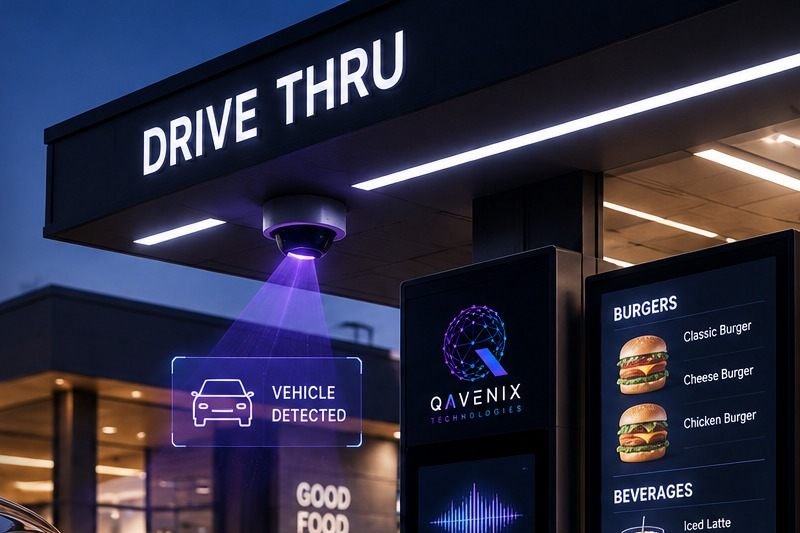
| Lane entry | Counts and times arriving cars | Car detection by camera for timers and queue monitoring |
| Preview board | Lets drivers decide before the speaker | A digital menu board readable through a windshield |
| Order point | Takes the order | Menu board, speaker post, two-way audio and an order confirmation display |
| Payment window | Takes payment | POS with a card and wallet reader within arm's reach |
| Pickup window | Hands over the right order | Customer display, kitchen display link and a stage timer |
| Pull-forward bay | Holds slow orders off the lane | An order-ready screen and a runner |
| Back office | Runs and measures the lane | Analytics dashboard and central management |
Every point that has a screen, a speaker or a camera needs power and data. Run conduits to each of them before the paving goes down; adding them later means cutting the asphalt.
Details that save seconds on every car
- A menu board drivers can read - large type, fewer items and content that changes by daypart, so the longest stage, deciding, gets shorter.
- A speaker post at the driver's window - the right height, shielded from road noise, with audio clear enough that nobody has to repeat the order.
- Windows at car-window height - the card reader and the bag should be within the driver's reach without opening the door.
- Shade and light - a canopy over the order point for the summer sun, and good lighting for night service.
- Arabic and English everywhere - menu board, confirmation display and receipts, because the lane serves both.
What Egyptian sites demand
- Outdoor screens built for heat and dust - high brightness to beat direct sun, and enclosures rated for summer temperatures and sandstorm seasons.
- Power that rides through cuts - a UPS for the order point, the POS and the network, so a short outage does not stop the lane.
- Cabling designed in, not added on - structured cabling and conduits planned with the civil works.
- Approvals checked early - lane layout, access and signage may need local approvals; confirm them with your architect before you order equipment.
A planning checklist
- Measure or estimate cars per peak hour and minutes per car.
- Calculate the average queue and plan stacking well above it.
- Choose the layout: single, side-by-side or tandem, with or without a pull-forward bay.
- Place the preview board, order point, windows and bay on the site plan.
- Run conduits for power and data to every point before paving.
- List the equipment for each point and how it connects to the POS and kitchen.
- Plan the kitchen for drive-thru peaks, then test with a soft opening and read the timers.
How it connects to the rest of the restaurant
Lane orders should land in the POS and on the kitchen display like any other channel, with no re-typing, while digital menu boards and the customer display keep the lane moving. Our kitchen display guide covers the kitchen side.
Where QAVENIX fits
The QAVENIX drive-thru system covers the whole lane: order taking with integrated headset and speaker audio, order confirmation displays, a customer display at the pickup window, queue monitoring, per-stage timers, performance analytics by lane and daypart, and central management across branches, in single, dual or tandem layouts. It connects natively to our POS and kitchen displays, HME is among our technology partners, and our engineers plan the conduits, install the lane and train the crew.
Frequently asked questions
How many cars should a drive-thru lane hold?
Start with your peak hour: cars arriving per minute multiplied by the minutes each car spends in the lane gives the average number of cars in it (Little's Law). Arrivals bunch, so plan stacking well above that average and make sure the queue never spills onto the street.
Is side-by-side ordering better than a single lane?
It doubles order taking at peak, but needs more width and correct order sequencing where the two lanes merge. A single lane suits moderate peaks and tight sites; side-by-side pays off when peak demand is more than one order point can handle.
What equipment does a drive-thru need?
A digital menu board, a speaker post with two-way audio and crew headsets, an order confirmation display, a POS with a card reader at the window, car detection and timers, a customer display at pickup, kitchen display integration and an analytics dashboard.
When should the technology be planned in a new build?
Before construction. Conduits for power and data must reach every point on the lane before the paving goes down; adding them later means cutting the asphalt and closing the lane.