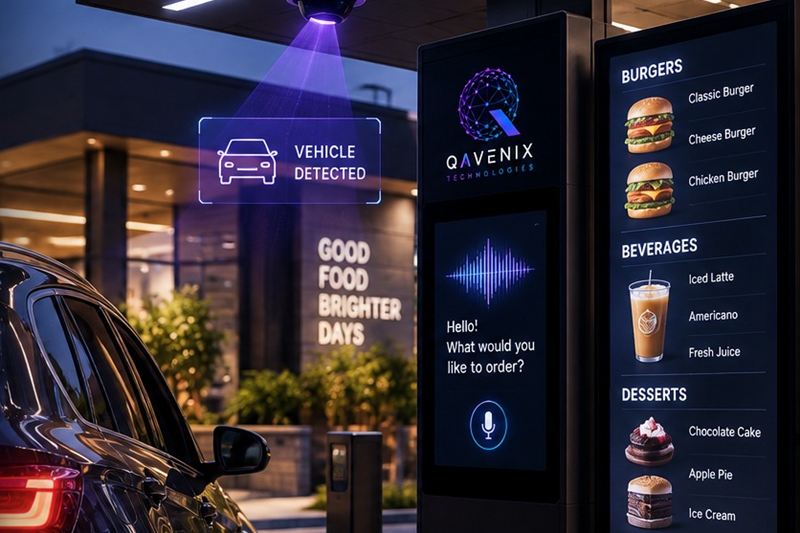
Drive-thru is the one restaurant format where the customer can leave without ever stopping. There is no queue to stand in and reconsider - just a steering wheel and a glance down the lane. If the line looks slow, the car keeps driving, and that order never appears in any report. That is what makes drive-thru brutally honest: the lane either wins seconds or loses customers, and it does both silently.
With QSR brands pushing into Egypt's new cities, ring roads and fuel-station plazas, more operators are building lanes than ever - many for the first time. This guide covers what a drive-thru system actually consists of, the numbers that run it, and where the seconds really go.
The five components of a lane that works
1 - Audio you don't have to fight
Everything starts at the speaker post. If the crew member hears traffic noise and half the words, every order becomes a repeat-back session - seconds burned and errors seeded. Professional two-way audio with noise cancellation, comfortable headsets for the crew, and a mic tuned for an idling engine is not a luxury; it is the foundation the rest of the lane stands on.
2 - An order confirmation display
The customer watches the order build on screen while speaking - in Arabic or English. Wrong item? Corrected at the speaker, in two seconds, instead of at the window after the kitchen already made it. The confirmation display is where accuracy is won, and accuracy is speed: a remade sandwich costs more lane-seconds than any slow greeting ever will.
3 - Timers on every stage
Greet time, order time, pay window, hand-out - a proper system clocks each car through each stage and shows the lane's pulse live on screen. Not to decorate a wall: to answer, with data, the only operational question that matters - where exactly are we slow? Teams with visible timers race them. Teams without them argue.
4 - Kitchen synchronization
The order fired at the speaker must appear on the kitchen display instantly, sequenced against the cars actually in the lane. If the kitchen works from paper or a disconnected screen, cars arrive at the window before their food has started - and the whole lane idles behind one wait. Lane speed is kitchen speed wearing a different uniform.
5 - Queue monitoring and analytics
Cameras and sensors that count cars, flag balking (cars that approach and leave), and feed a dashboard of cars-per-hour, average total time and per-daypart performance - across every branch, from anywhere. This is how a two-branch operator decides where the third lane goes, and how a franchise proves standards to the brand.
The four numbers that run a lane
- Total experience time - entry to hand-out. The global QSR benchmark conversation lives in the 4-6 minute range; every operator should know their own number before arguing with it.
- Order accuracy - the percentage of cars that drive away with exactly what they asked for. Below the high nineties, your lane is manufacturing refunds and remakes.
- Cars per peak hour - the only capacity number that matters. Average-hour throughput flatters everyone.
- Balk rate - cars that looked and left. Invisible without cameras, and usually the most expensive number on this list.
Where seconds are actually lost
- The repeat-back loop - bad audio turning every order into "sorry, say again?" Twenty seconds per car, every car.
- Window corrections - no confirmation display, so errors surface after cooking. One remake stalls the entire lane behind it.
- Payment fumbling - card terminal inside the building instead of at the window arm's reach; no wallet/tap support while Egypt's drivers increasingly expect it.
- Kitchen desync - food starting when the car reaches the window instead of when the order was spoken.
- Menu indecision - a cluttered static board read through a windshield at noon. A clear digital menu board with dayparted content shortens the longest stage of all: deciding.
What Egypt specifically demands
- Heat and dust-rated outdoor hardware - displays and speaker posts that survive 45° summers and sandstorm seasons, with brightness that beats direct sun.
- Arabic + English everywhere - menu boards, confirmation screens and receipts, switching cleanly, because the lane serves both.
- Cash and card together - fast card/wallet at the window with a cash drawer workflow that doesn't stall the lane.
- Power and network resilience - a lane that dies with the internet creates instant chaos; local resilience in the POS layer keeps cars moving.
Drive-thru is one layer of a connected stack - see our restaurant technology stack guide for how it fits alongside POS, kitchen displays and signage. Planning a new lane? Start with our drive-thru planning guide.
Where QAVENIX fits
The QAVENIX drive-thru system is the full lane in one platform: multi-lane support, noise-cancelled audio, bilingual order confirmation displays, stage timers, queue monitoring and real-time analytics - natively integrated with our POS, kitchen displays and outdoor menu boards, so an order spoken at the post hits the kitchen the same second. Designed for Egyptian conditions, installed and supported by our own engineers.
Frequently asked questions
Do I really need timers, or are they just screens for managers?
Timers are how a lane learns. Without them, nobody knows which stage is slow and every shift argues from impressions; with them, the bottleneck is visible in a day and targets become real. The slowest station is rarely the one everyone suspected.
Should I build one lane or two?
Count your busiest 90 minutes, not your average. If a single lane backs onto the street at peak, you are already paying for the second lane in lost orders - you're just not receiving it. And whatever the lanes feed, the kitchen must keep up with.
What does an order confirmation display actually change?
Mistakes die at the speaker instead of surfacing at the window after cooking. Accuracy up, remakes down, hand-out faster - usually the highest-return single upgrade on an existing lane.
Can it work with the POS and kitchen screens I already have?
It must - ask the integration question before any hardware question. Lane orders should land in the POS and kitchen like any other channel, with no re-typing. This is where single-platform setups beat stitched-together ones.