Ask an Egyptian business owner where their sales live and you will usually get the same answer: in WhatsApp chats, in an Excel sheet someone updates when they remember, and in the heads of two very busy people. It works - until the day it doesn't. A hot lead from Facebook sits unanswered for four days. A quotation goes out and nobody follows up. A customer calls angry and no one can see what was promised. None of these are people problems. They are system problems.
That system has a name - a CRM - and this guide covers what it actually does, why the famous global ones fit Egypt awkwardly, and what to check before you commit. We will be upfront: we got frustrated enough with the options that we built our own. That story is at the end.
What a CRM actually does
Strip away the jargon and a CRM is one connected record of your commercial life, following each customer through four moments:
- Capture - every lead from Facebook, your website, exhibitions or phone calls lands in one list, scored and assigned, instead of scattered across inboxes.
- Sell - deals move across a visible pipeline, so you can see this month's likely revenue and which deals have quietly stalled.
- Close the paperwork - quotation becomes sales order becomes invoice becomes payment, without retyping, with tax handled correctly.
- Keep the customer - complaints and requests become tickets with deadlines instead of forgotten voice notes.
The payoff is not any single feature. It is that nothing falls between the cracks - and that, for the first time, your numbers (leads this month, conversion rate, pipeline value, collection) exist without anyone compiling a report.
Why global CRMs feel wrong here
The big international platforms are excellent software - built for a different market. The friction shows up in the same places every time:
- Arabic is an afterthought. Menus get translated; the documents your customer actually sees often don't. Half-English quotations and left-to-right layouts your team fights daily.
- Money lives in dollars. Per-user, per-month USD pricing multiplies painfully, and the invoicing modules don't think in EGP and 14% VAT - so billing stays in a separate program and the "one record" promise breaks.
- Leads come from the wrong places. In Egypt, leads arrive from Facebook forms and WhatsApp conversations - not the email-first funnels these tools assume. If capturing a Facebook lead requires a third-party connector and a monthly fee, it will break the week you are too busy to notice.
- Support is far away. A question answered in a help-center article at 2 AM Pacific time is not support; a person who knows your setup is.
The 8-point CRM checklist for Egypt
- Arabic and English, end to end. Not translated menus - the full interface, quotations, invoices and email templates, properly right-to-left.
- Capture where your leads actually are. Direct Facebook Lead Ads intake, website form intake and spreadsheet import with de-duplication - no copy-paste jobs that depend on someone's memory.
- A pipeline you can see. Deals as cards across stages with values, expected close dates and flags for deals going stale - so Monday's meeting runs off the screen, not off memory.
- Quotation to invoice in one chain. EGP, 14% VAT, price lists, and bilingual documents that look right - generated from the deal, not retyped into Word.
- Campaigns on email and WhatsApp. Segment your database, send bilingual campaigns, and follow up automatically - to the channels Egyptian customers actually read.
- Support tickets with deadlines. Every complaint gets an owner, an SLA timer and a thread - and management sees response times without asking.
- Automation that removes the forgetting. New lead → assigned and scheduled. Deal stuck → someone is nudged. Invoice overdue → a reminder fires. The system does the remembering.
- Your data, protected. Role-based permissions, a full audit trail, two-factor authentication - and your data exportable, because it is yours.
Why we built QAVENIX CRM
We sell and install technology solutions across Egypt - POS, kiosks, signage, infrastructure. Which means we have the exact problem described above: Facebook campaigns producing leads, quotations in two languages, 14% VAT invoices, follow-ups, support visits. We ran the checklist on the market, kept hitting the same four frictions, and did what engineers do: built it ourselves, then ran our own business on it.
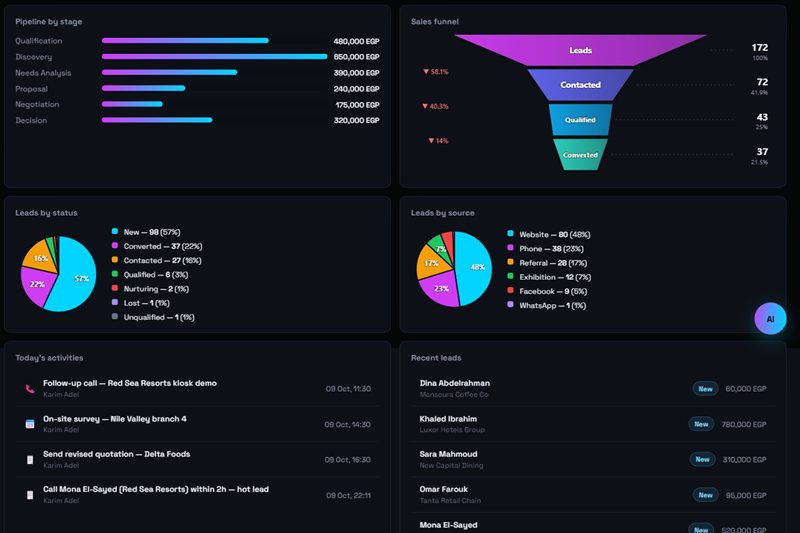
QAVENIX CRM is that platform - bilingual Arabic/English to the last template, with Facebook and website lead intake built in, an 8-stage visual pipeline, the full quote-to-invoice chain in EGP with 14% VAT, email and WhatsApp campaigns, SLA-timed support tickets, workflow automation, a customer portal where clients approve quotes and view invoices, and an assistant that answers "what's happening with this customer?" on demand. It runs in the cloud at crm.qavenix.com, secured with role permissions, audit trails and two-factor authentication.
Every screenshot on the solution page - including the cover of this article - is the real product. The dashboards you see are how we watch our own pipeline every morning.
If your invoicing must also talk to the tax authority, that is a separate, solvable layer - see our guide to e-invoicing in Egypt and our e-invoicing solutions.
Frequently asked questions
Is a CRM only for big companies?
No - smaller teams bleed more from each lost lead. Five salespeople forgetting two follow-ups a week lose proportionally more than a corporation with a hundred reps. Start with your Excel sheet imported and grow from there.
Does a CRM work properly in Arabic?
Only if built for it. Test what reaches your customer: Arabic quotations and invoices, Arabic email templates, a true right-to-left interface. Translated menus alone mean your team will live in half-English screens.
We run on Excel and WhatsApp today. How hard is the switch?
Days, if you start small: import the sheet, connect your lead sources, run leads and pipeline first, add the rest in stages. The mistake is switching everything on at once.
Can it capture leads from Facebook and my website automatically?
It should - that is where Egyptian leads come from. In QAVENIX CRM a Facebook or website form submission becomes a scored, de-duplicated, assigned lead in seconds, with no connector fees and no copy-paste step.