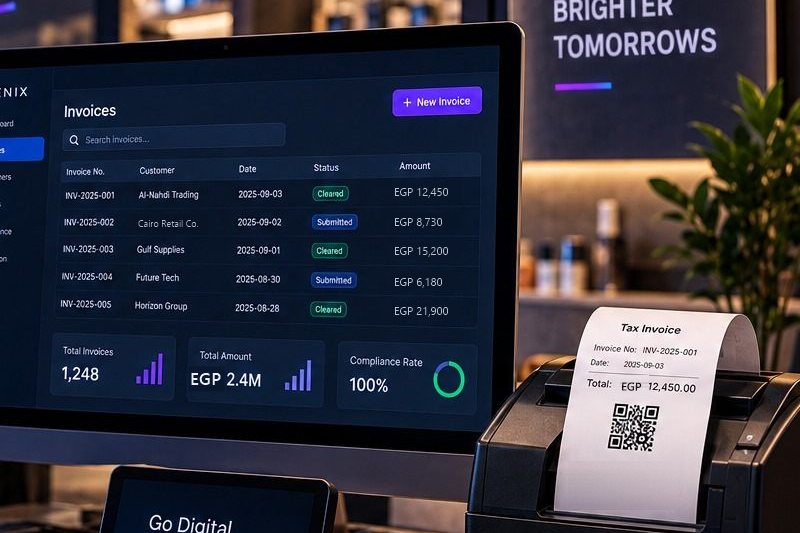
E-invoicing in Egypt means issuing tax documents electronically through the Egyptian Tax Authority (ETA) instead of on paper. It has two parts: the e-invoice system for sales to companies and government bodies (B2B and B2G), and the e-receipt system for sales to consumers at the point of sale (B2C). E-invoices are signed with an electronic seal and validated by ETA; e-receipts are sent from registered POS devices and carry a QR code that opens the receipt on ETA's portal.
If you run a restaurant, café or shop in Egypt, this is not a topic you can postpone. It is also less painful than it sounds when your POS is built for it. This guide covers who must comply, what ETA requires on every receipt, the steps to get compliant, and the mistakes we see most often.
The two systems: e-invoice and e-receipt
Egypt's digital tax framework rests on the Unified Tax Procedures Law (No. 206 of 2020), and most restaurants and retailers end up dealing with both systems:
| E-invoice | E-receipt | |
|---|---|---|
| Covers | Sales to companies and government bodies (B2B, B2G) | Sales to consumers at the point of sale (B2C) |
| Issued from | Your ERP or invoicing system | A POS device registered with ETA |
| Proof on the document | Electronic seal signature, then a UUID once ETA validates it | A UUID and a QR code printed on the receipt |
| Who must join | Registered taxpayers, phased in since November 2020 | Businesses named in ETA phase decisions |
| Buyer details | The buyer's tax registration number | Name and national ID only for individual buyers from EGP 150,000 |
A restaurant selling meals to walk-in guests lives mainly in the e-receipt world. The moment it also bills companies (catering contracts, corporate accounts, mall management), the e-invoice system applies too.
Who must comply, and when?
E-invoices: the rollout began in November 2020 with a first group of large taxpayers and was extended in phases until it covered registered taxpayers across the economy. If you are registered for tax, plan on issuing e-invoices for your business sales.
E-receipts: ETA brings businesses in by decision. Each phase decision lists the tax registration numbers it covers, and there is no general turnover threshold that decides it for you. Resolution No. 281 of 2025, for example, added a group that had to start issuing e-receipts on 15 September 2025, and further phases have followed. To check your own status, enter your tax registration number on the e-receipt inquiry page of the ETA website.
Why e-invoices matter even before your e-receipt phase
Since 1 July 2023, only electronic invoices are accepted as proof of deductible costs, and VAT deductions and refunds run through e-invoices as well (Law No. 30 of 2023 and Ministerial Decree No. 188 of 2023). In practice, a supplier's paper invoice can cost you the deduction. Ask every supplier for e-invoices, and make sure the invoices you issue to companies go through the system.
ETA e-receipt requirements: what every receipt needs
Once your business is in an e-receipt phase, each receipt your POS issues has to meet ETA's specification:
- A registered POS device. Every till that issues receipts is registered with ETA and linked to your branch, identified by its serial number.
- Seller details on every receipt. Your tax registration number, branch code and activity code travel with each receipt.
- Coded items. Each item carries a GS1 or EGS code. Free-text item names on their own get rejected, so the menu has to be coded before go-live.
- A UUID and a QR code. Each receipt gets a unique ID, and the printed receipt carries a QR code that opens it on ETA's portal so anyone can verify it.
- Buyer details only when needed. For an individual buyer, the name and national ID become mandatory once a receipt reaches EGP 150,000 under the current receipt specification. Everyday restaurant sales do not need them.
- Submission as you sell. Receipts are sent to ETA as they are issued. When the internet drops, the POS has to queue them and send them as soon as the connection returns.
- Returns that reference the original. A refund is issued as a return receipt linked to the original sale, not by deleting anything.
How to get compliant, step by step
- Confirm your obligations. E-invoices for your business sales, and e-receipts if your registration number appears in a phase decision.
- Set up your ETA profile. Register the company on ETA's invoicing portal with a valid tax registration number and an authorized representative, then register the ERP and POS systems that will submit documents.
- Get an electronic seal certificate. Issued by a licensed provider, it signs your e-invoices so ETA can trust they came from you.
- Code your catalog. Map every product and menu item to a GS1 or EGS code. This takes longer than most teams expect, so start early.
- Integrate, do not re-type. Connect your POS and ERP to ETA's interfaces so documents are generated and submitted automatically, and register every POS device.
- Test, go live branch by branch, and archive. Test in ETA's pre-production environment, go live outside peak hours, and keep every document retrievable for the legal retention period.
The mistakes we see most often
- Treating it as an accounting-only project. For restaurants and retail, compliance happens at the POS - if the till cannot generate compliant receipts, no amount of back-office work fixes it.
- Manual double entry. Selling on one system and re-typing invoices into another "for the tax portal" doubles the work and multiplies errors. The integration should be automatic.
- Ignoring offline behaviour. Internet drops; sales continue. Your system must queue documents and submit them when the connection returns - without losing anything.
- No plan for item coding. E-invoicing uses standardized item coding (GS1/EGS). Cleaning up your product catalog is part of the project, not an afterthought.
- Accepting paper invoices from suppliers. Since July 2023 only e-invoices prove deductible costs, so a paper invoice can cost you the deduction.
- Archiving as an afterthought. Submitting documents is half the job; being able to retrieve and prove them later is the other half.
How QAVENIX handles this
We built e-invoicing directly into the QAVENIX POS platform, so compliance is a property of the system rather than a separate chore:
- Invoices and receipts generated in the required format and submitted automatically - with QR codes on every receipt.
- ERP and POS integration, so documents flow from where you actually sell. No double entry.
- Offline-safe queuing, automatic retries, and live status so you always know what has been submitted and accepted.
- Secure archiving with fast retrieval, plus an audit trail of who issued what and when.
Our team has implemented e-invoicing regimes hands-on across the region, and we design the rollout around your business - branch by branch, without stopping sales for a single day.
Frequently asked questions
Is e-invoicing mandatory in Egypt?
Yes. E-invoicing for sales to companies and government bodies has been rolled out in phases since November 2020 and now covers registered taxpayers broadly. Consumer sales are covered by the e-receipt system, which ETA extends through phase decisions that name the businesses included.
What is the difference between an e-invoice and an e-receipt in Egypt?
An e-invoice covers B2B and B2G sales: a structured document signed with an electronic seal and validated by the Egyptian Tax Authority. An e-receipt covers B2C sales at the point of sale: each receipt is sent from a registered POS device and carries a QR code for verification. Restaurants and retailers usually need e-receipts, plus e-invoices for any company they bill.
What are the ETA e-receipt requirements?
Each receipt must come from a POS device registered with ETA, carry the seller's tax registration number, branch code and activity code, use GS1 or EGS item codes, and get a UUID and a QR code that opens the receipt on ETA's portal. Receipts are submitted as they are issued, queued during internet outages, and refunds are issued as return receipts that reference the original sale.
How do I know if my business must issue e-receipts?
ETA brings businesses into the e-receipt system through phase decisions that list the tax registration numbers covered, so there is no general turnover threshold. Enter your tax registration number on the e-receipt inquiry page of the ETA website to see whether your business is already obligated or still waiting for its phase.
Do e-receipts need the customer's national ID?
Not for everyday sales. Under the current e-receipt specification, the buyer's name and national ID are only mandatory when the buyer is an individual and the receipt reaches EGP 150,000 or more.
Can I deduct supplier costs without an e-invoice in Egypt?
Since 1 July 2023, only electronic invoices are accepted as proof of deductible costs, and VAT deductions and refunds also run through e-invoices, under Law No. 30 of 2023 and Ministerial Decree No. 188 of 2023. A paper invoice from a supplier can cost you the deduction, so ask your suppliers for e-invoices.
What does a restaurant need to become compliant?
An ETA portal profile, an electronic seal certificate for e-invoices, a coded menu (GS1 or EGS), a POS and ERP connected to ETA's interfaces with every POS device registered, QR codes on receipts, and secure archiving. With an integrated platform, all of this happens automatically at the point of sale.
Can my existing POS work with Egypt's e-receipt system?
Only if it can produce receipts in ETA's format, register its devices, use coded items and submit reliably, including catching up after internet outages. Many older systems cannot. QAVENIX builds e-invoicing and e-receipts into its POS platform, so compliance happens with every sale.