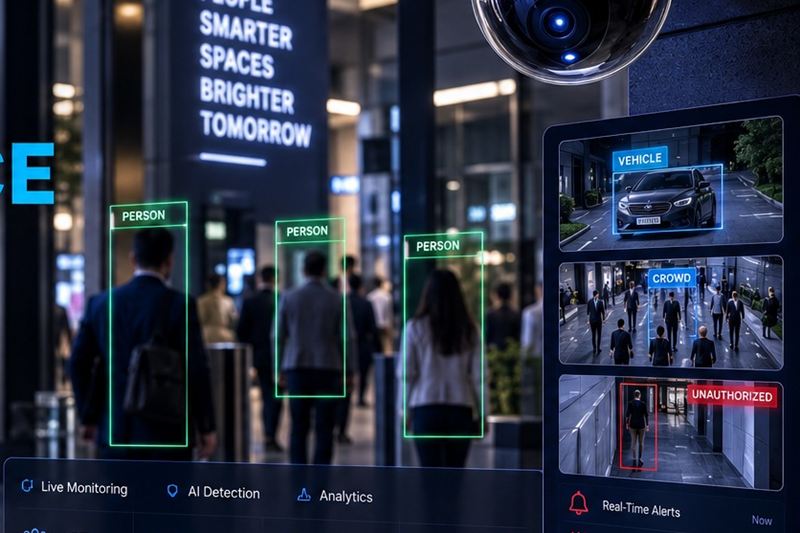
AI CCTV, also called video analytics, adds software to security cameras so they recognise people, vehicles and objects in real time instead of only recording. The system counts visitors at each entrance, notices when a queue is building, and sends an alert with the video clip while something is happening, not the next morning when someone finally reviews the recording.
Most stores in Egypt already have cameras. In many of them, the recorder runs all day and nobody watches it until something goes missing. The footage exists, but it only answers questions after the loss. This guide covers what changes when the same cameras start counting and alerting, the numbers a retailer can finally see, and what it takes to make those numbers trustworthy in an Egyptian store or mall.
Recording is not the same as watching
Traditional CCTV is a recorder. It is useful after an incident, as evidence. AI video analytics is closer to a sensor: it watches every camera at once, all day, and turns what it sees into counts and events. A guard can watch a few screens with real attention for a limited time. Software can watch all of them, every hour, and only call a person when something needs a person.
Four things AI cameras do for a retailer
1. Count people at every entrance
Footfall by entrance, by hour and by day, from cameras placed over the doors. It is the number most store managers have never had, and it explains a lot: a quiet Tuesday with high footfall is a conversion problem, not a traffic problem.
2. Turn footfall into conversion
Put footfall next to the number of sales from the POS and you get the store's conversion rate: how many visitors actually bought. It is the single best measure of whether staffing, layout and stock are working, and it cannot be calculated without counting the people who walked in.
3. Watch the queue before customers leave it
The system can notice when the line at the cashier passes a set length or waiting time and alert the supervisor to open another till. The same logic works in pharmacies, bank branches and service counters.
4. Raise alerts instead of filling a hard disk
Intrusion after closing time, someone in a stockroom or restricted area, an object left behind in a mall corridor: each becomes an alert on the right person's phone within seconds, with the clip attached, instead of a file nobody opens.
Traditional CCTV or AI video analytics?
| Traditional CCTV | AI video analytics | |
|---|---|---|
| What it produces | Hours of recordings | Counts, events and alerts |
| When it helps | After an incident | While it is happening |
| Who watches | A guard, when available | Software, every camera, all day |
| Footfall data | None | By entrance, hour and zone |
| Queues | Seen only if someone looks | Alert when a line builds up |
| Several branches | One recorder per site | All branches on one dashboard |
| Weak point | Nobody reviews the footage | Needs good placement and tuning |
Analytics does not replace recording. Good systems do both: they record securely and they watch.
The numbers a store can finally see
- Footfall by hour and day - the real shape of demand, which is rarely the shape the staff rota assumes.
- Conversion rate - sales divided by visitors. If footfall rises while conversion falls, the store is losing people it already attracted.
- Staffing gap - visitors per staff member by hour. It shows the hours when customers outnumber the team.
- Queue length and waiting time - the moments when lines grow long enough to cost sales.
- After-hours events - alerts outside opening hours, by site. A pattern here is worth more than any single clip.
What Egyptian stores and malls need to get it right
- Counting cameras placed for counting - mounted above the entrance and looking down, not the same angled camera that watches the door for security. Placement decides accuracy more than software does.
- Light that does not blind the camera - glass storefronts and strong sun create glare and silhouettes at the door. Wide dynamic range cameras and careful angles fix most of it.
- Storage sized for your retention period - decide how many days of footage to keep, then size the recorder for it. A disk that fills up silently is the most common failure.
- Power and network that stay up - a UPS for recorders, switches and key cameras, and structured cabling instead of improvised runs.
- One view across branches - head office should see every store's counts and alerts without calling each branch.
- Privacy handled properly - video of identifiable people is personal data under Egypt's Personal Data Protection Law (Law No. 151 of 2020). Post clear notices, limit who can view footage, keep it only as long as needed, and take legal advice for any use beyond security and counting.
How to roll out AI cameras in a store
- List the questions you want answered: footfall, queues, after-hours security, or all three.
- Survey the site: entrances, cash points, stockrooms, lighting and existing cameras.
- Keep the cameras that can feed analytics and replace the ones that cannot.
- Mount counting cameras over the entrances and set the counting lines.
- Size recording storage for your retention period and put it on a UPS.
- Decide who receives each type of alert and test it on their phones.
- Check counts against a manual count, then review footfall and conversion every week.
How it connects to the rest of the business
Cameras become far more useful when their counts meet other data. Footfall plus POS sales gives conversion, queue alerts trigger staff action, and AI and data dashboards put every branch side by side. For control rooms and large sites, a video wall gives operators one shared view. Our restaurant technology stack guide shows where cameras sit among the other systems in a restaurant.
Where QAVENIX fits
QAVENIX AI surveillance recognises people, vehicles and objects in real time, counts footfall by entrance, hour and zone, monitors queues, and sends intrusion, perimeter, unattended-object and restricted-area alerts to the right phone with the clip attached. Every branch and camera appears on one central dashboard, recordings are kept with retention policies, encrypted storage and audited access, and the hardware is professional cameras from leading brands such as Hikvision, installed by our own engineers.
Frequently asked questions
What is AI CCTV?
AI CCTV, or video analytics, is security cameras combined with software that recognises people, vehicles and objects in real time. Instead of only recording, it counts visitors, notices queues and sends alerts while an event is happening.
How accurate is people counting?
It depends mostly on placement and light. A counting camera mounted above the entrance and looking down, with no direct sun in the lens, counts far more reliably than an angled security camera. Check the counts against a manual count for an hour before you rely on them.
Do I need to replace my existing cameras?
Not always. Many recent IP cameras can feed analytics, while older analog systems usually limit what is possible. A site survey shows which cameras to keep, which to move and which to replace.
What does Egypt's data protection law mean for store cameras?
Video of identifiable people is personal data under Egypt's Personal Data Protection Law (Law No. 151 of 2020), so treat it that way: post clear notices, restrict access to footage, keep it only as long as needed, and take legal advice before using video for anything beyond security and counting.